Planned Merchandise Procurement for Southern California Schools
By Ricardo Lopez, Partnership Manager, Fifth Sun Pictures
Published August 13, 2026
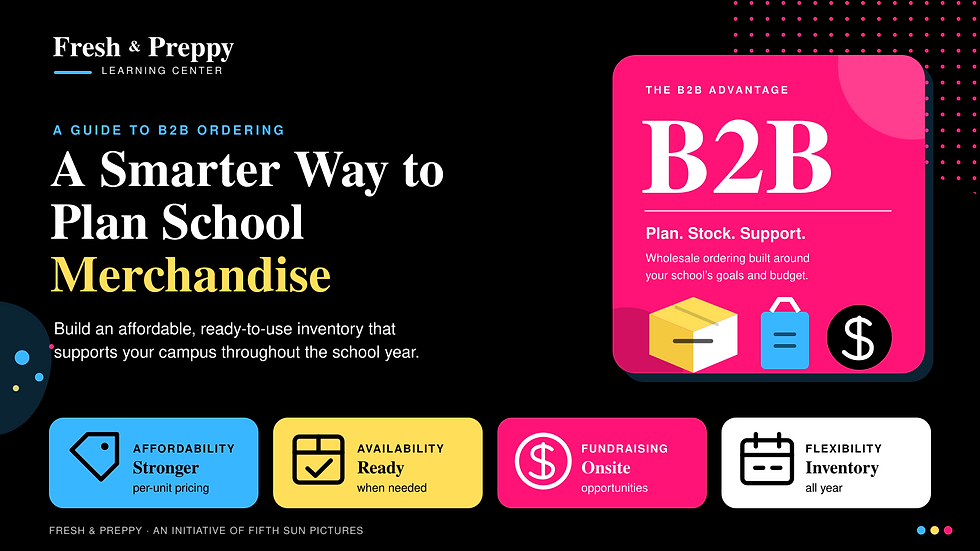
How B2B ordering can improve affordability, availability, fundraising, and campus engagement
School merchandise serves many purposes. Uniforms help students arrive prepared. Spirit wear strengthens school identity. Staff apparel creates consistency during events. Promotional products can support enrollment, recognition programs, fundraising, and community engagement.
However, when merchandise is purchased only through individual orders after the school year begins, schools have limited control over pricing, availability, and distribution. Families may need to wait for products to be produced or shipped, while campuses may find themselves preparing for important events without the merchandise they need.
A planned B2B ordering strategy offers schools a more proactive approach.
What does B2B ordering mean for a school?
B2B stands for “business-to-business.” In this context, it simply means that a school purchases merchandise directly from a vendor in planned quantities at wholesale pricing.
Instead of waiting for students, parents, or staff members to place individual orders, the school begins with an inventory selected around its priorities, budget, and anticipated demand.
That inventory can then be:
Distributed directly to students or staff.
Sold onsite throughout the school year.
Used during orientations, enrollment events, spirit weeks, and recognition programs.
Included in student, staff, club, or event packages.
Replenished as popular products and sizes begin to run low.
B2B ordering does not mean that a school needs to purchase an excessive amount of inventory. The goal is to begin with a thoughtful product mix, monitor demand, and restock strategically.
Why planned inventory creates a stronger foundation
Individual ordering can still provide convenience, particularly for optional or less frequently requested items. However, relying exclusively on individual purchases can leave a school reacting to demand instead of preparing for it.
A B2B model gives the school greater control over its merchandise program.
Area | Individual-order approach | Planned B2B approach |
Purchasing | Each person orders separately | The school purchases a planned inventory |
Pricing | Based on individual production | Wholesale pricing based on quantity |
Availability | Products are made after orders are placed | Priority products are already available |
Campus control | Limited visibility into purchasing and demand | School selects products, quantities, and timing |
Events | Merchandise may require advance individual ordering | Inventory can be prepared before the event |
Fundraising | Limited opportunity for the school | School may sell inventory to generate proceeds |
Reordering | Driven by individual customers | Driven by actual campus demand |
The two approaches can complement each other, but B2B ordering provides a stronger foundation when affordability, immediate availability, and campus-wide planning are priorities.
1. Make products more affordable

One of the primary advantages of B2B ordering is stronger per-unit pricing.
Producing merchandise in planned quantities is generally more efficient than fulfilling items one at a time. Those efficiencies can help schools lower the cost of uniforms and spirit wear for families or create more value within their existing merchandise budget.
Depending on the school’s goals, wholesale pricing can be used to:
Offer products to families at a more accessible price.
Provide uniforms or apparel directly to selected students.
Build merchandise into enrollment, orientation, or student-support packages.
Create room for fundraising while maintaining a reasonable selling price.
The goal is not simply to purchase more. It is to make each dollar work harder for the school and its community.
2. Keep essential products available throughout the year
Back-to-school season may create the greatest initial demand, but the need for school merchandise continues long after the first day of classes.
New students may enroll during the year. Uniforms may need to be replaced. Staff members may join the campus. Clubs and programs may organize new activities. Families may also decide to purchase spirit wear after seeing it used around campus.
Maintaining a core inventory allows the school to respond to these needs without restarting the entire ordering process each time.

A strong initial inventory might include:
Common uniform shirts and sizes.
Core school T-shirts or sweatshirts.
Staff apparel.
Lanyards and identification accessories.
Enrollment and promotional materials.
Products connected to upcoming events or programs.
Rather than predicting every possible need, schools can focus on their highest-priority products and replenish according to actual demand.
3. Prepare for important campus moments

Many merchandise needs are tied to specific dates and events. Waiting until those events are approaching can create unnecessary pressure on administrators and staff.
Planned B2B ordering allows schools to prepare products in advance for:
Student and parent orientations.
Enrollment and recruitment events.
Back-to-school nights.
Spirit weeks and school celebrations.
College and career events.
Staff development days.
Student recognition and attendance programs.
Athletic, club, and extracurricular activities.
Open houses and community events.
Having merchandise ready gives the school more flexibility in how it is distributed, displayed, bundled, or sold.
4. Create onsite fundraising opportunities

A school merchandise program can do more than provide apparel. It can also create a recurring fundraising opportunity.
When a school purchases products at wholesale pricing, it may choose to sell those products onsite at a reasonable retail price. The difference between the wholesale cost and selling price can create funds that support school programs and discretionary needs.
Potential uses could include:
Student activities and incentives.
Clubs and extracurricular programs.
Campus events.
Staff or student recognition.
Classroom and program materials.
Other approved school priorities.
All sales and use of proceeds should follow applicable school and district policies. However, with the proper internal process, merchandise can become a useful fundraising tool rather than simply another expense.
Unlike a single fundraising campaign, school merchandise can remain available throughout the year. Families receive a tangible product, students build school pride, and the campus gains an additional way to support its programs.
5. Improve budgeting and purchasing decisions
A B2B strategy begins with a plan.

Before placing an order, the school can identify its budget, review priority products, compare quantities, and determine which items are most likely to be used or sold.
This creates greater visibility into:
Total upfront costs.
Per-unit pricing.
Recommended selling prices.
Potential fundraising margins.
Product and size distribution.
Reordering priorities.
Upcoming events and deadlines.
Schools can begin with a focused starter inventory instead of attempting to purchase every possible product. Sales and distribution patterns can then guide future orders.
The result is a more manageable and informed purchasing process.
6. Build a consistent school identity
Consistent merchandise helps make a school’s identity visible across campus.
When designs, colors, and products are planned together, staff and students receive merchandise that feels connected rather than pieced together across separate orders.
A coordinated program can help schools create consistency across:
Uniforms and everyday apparel.
Staff clothing.
Spirit wear.
Clubs and student organizations.
Enrollment materials.
Events and campus celebrations.
Banners, signage, and promotional products.
This consistency can strengthen recognition, school pride, and the overall presentation of the campus.
Building the right inventory plan

A successful B2B program is not measured by how much inventory a school purchases. It is measured by how intentionally that inventory is selected and used.
A practical planning process includes five steps:
Step 1: Identify the school’s priorities
Determine whether the immediate focus is uniforms, staff apparel, spirit wear, fundraising, enrollment, an upcoming event, or a combination of needs.
Step 2: Establish a working budget
Knowing the available budget allows the school to compare product options and build an appropriate starting package.
Step 3: Select core products
Begin with items that have clear and predictable uses. Additional products can be introduced after the school understands what its community requests most often.
Step 4: Plan quantities and sizes
Use previous purchasing information, enrollment data, staff input, or family interest to create a reasonable starting mix. When reliable data is unavailable, begin conservatively and leave room for replenishment.
Step 5: Monitor and restock
Track which products, designs, and sizes move most quickly. Future orders can then be based on real demand rather than assumptions.
How Fresh & Preppy supports the process
Fresh & Preppy helps schools move from a general merchandise idea to a practical B2B inventory plan.
Participating schools receive:
Complimentary product designs and mockups.
Access to wholesale and bulk product options.
Guidance from a dedicated account manager.
Help identifying priority products and starting quantities.
Package recommendations based on the school’s goals and budget.
Digital materials to help introduce and promote merchandise.
Educational videos and planning resources through the Fresh & Preppy Learning Center.
Support with future replenishment and product expansion.
Our team works with each school to create a program that reflects its community, timeline, and available resources.
A more proactive approach to school merchandise
B2B ordering transforms school merchandise from a series of individual transactions into a planned campus resource.
It can help schools provide more affordable products, prepare for important events, maintain year-round inventory, strengthen their identity, and create new fundraising opportunities.
Most importantly, the model gives schools greater control over what they offer, when it is available, and how it supports their broader goals.
A strong merchandise program does not begin with the largest possible order. It begins with the right plan.
To begin developing a B2B inventory strategy for your campus, contact our B2B Specialist with your priority products, estimated budget, and preferred launch date.